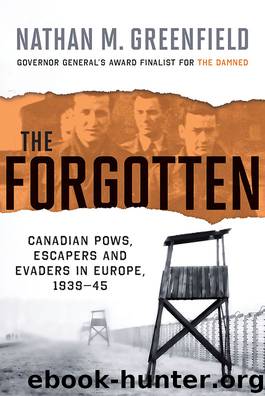
The Forgotten by Nathan M. Greenfield
Author:Nathan M. Greenfield [Greenfield, Nathan M.]
Language: eng
Format: epub
ISBN: 9781443404914
Publisher: HarperCollins Canada
Published: 2013-06-28T16:00:00+00:00
27 FEBRUARY 1944, STALAG II-D, STARGARD, NEAR STETTIN, GERMANY
SERGEANT MAJOR LISCOMB STANDS UP TO A NEW KOMMANDANT
They knew Stalag VIII-B was getting crowded. Still, the orders to board a train for another POW camp came as a surprise. “It was a strange feeling leaving the camp,” recalls Stan Darch. “Of course, we didn’t like it, but we knew it and we knew the guards and their routines. We knew that ‘Spitfire’ was a son of a bitch, and we knew which guards were gullible enough to supply us with what we wanted.” The going price for a radio tube was a reasonable 1,200 cigarettes. On their march to the train station, the 1,400 Canadians could not help but notice the black muzzles of the automatic weapons pointed at them.
They’d heard and seen the fleets of bombers overhead, and new arrivals had brought news of the victory in North Africa, the defeat of Italy and the Russians’ advances in the east. The train trip was, however, the Canadians’ first opportunity in a year and a half to judge the progress of the war themselves. “We were struck by the civilians that we saw. When they saw us, they did not appear too happy,” says Darch. The winter snows had covered the fields but could not hide the terrible toll the bombers had taken on houses, factories, roads and railways.
When they arrived at the POW camp near Stargard, the Kommandant asked if anyone could speak German. A man named Schillenberg of the South Saskatchewans said he did. “Later,” recalls Darch, “he told us that the Kommandant said to him, ‘That’s a German name. Why are you in the Canadian Army?’ and he answered, ‘I made my bread and butter in Canada. That’s why!’”
The men expected the usual statements about not trying to escape. Instead, Schillenberg told them that, according to the Kommandant, they’d all volunteered to work for Germany and as a result would be eligible for extra rations. As soon as the fetid men who had not yet been fed heard this, they started cursing. After a few moments, Sergeant Major Liscomb of the Essex Scottish stepped forward and the catcalls stopped, and the nonplussed Kommandant must have assumed that the natural order of command had re-established itself. Through Schillenberg, Liscomb told the Kommandant that he and the other NCOs would, quite simply, not be going out to work.
“Are you refusing to work as ordered?”
Liscomb answered, “No. We are not refusing. We [wish] to speak to the Swedish Red Cross representative before we go.”
The Kommandant stood his ground. “You have until tomorrow to make up your minds or you will be shipped to Poland.”
“Then you had better arrange for the train, sir. We could do with a ride anyway.”166 Then he turned his back on the Kommandant and returned to his place in the ranks. In the tense moments that followed, Liscomb wondered if his stand would cost him his life. It didn’t, but the Kommandant cut off Red Cross parcels and ordered a reduction in German rations.
Download
This site does not store any files on its server. We only index and link to content provided by other sites. Please contact the content providers to delete copyright contents if any and email us, we'll remove relevant links or contents immediately.
| Africa | Americas |
| Arctic & Antarctica | Asia |
| Australia & Oceania | Europe |
| Middle East | Russia |
| United States | World |
| Ancient Civilizations | Military |
| Historical Study & Educational Resources |
The Radium Girls by Kate Moore(12035)
100 Deadly Skills by Clint Emerson(4931)
Rise and Kill First by Ronen Bergman(4797)
The Templars by Dan Jones(4691)
The Doomsday Machine by Daniel Ellsberg(4493)
The Rape of Nanking by Iris Chang(4220)
Killing England by Bill O'Reilly(4008)
Stalin by Stephen Kotkin(3973)
Hitler in Los Angeles by Steven J. Ross(3948)
12 Strong by Doug Stanton(3554)
Hitler's Monsters by Eric Kurlander(3347)
Blood and Sand by Alex Von Tunzelmann(3207)
The Code Book by Simon Singh(3197)
Darkest Hour by Anthony McCarten(3135)
The Art of War Visualized by Jessica Hagy(3013)
Hitler's Flying Saucers: A Guide to German Flying Discs of the Second World War by Stevens Henry(2758)
Babylon's Ark by Lawrence Anthony(2685)
The Second World Wars by Victor Davis Hanson(2529)
Tobruk by Peter Fitzsimons(2521)
